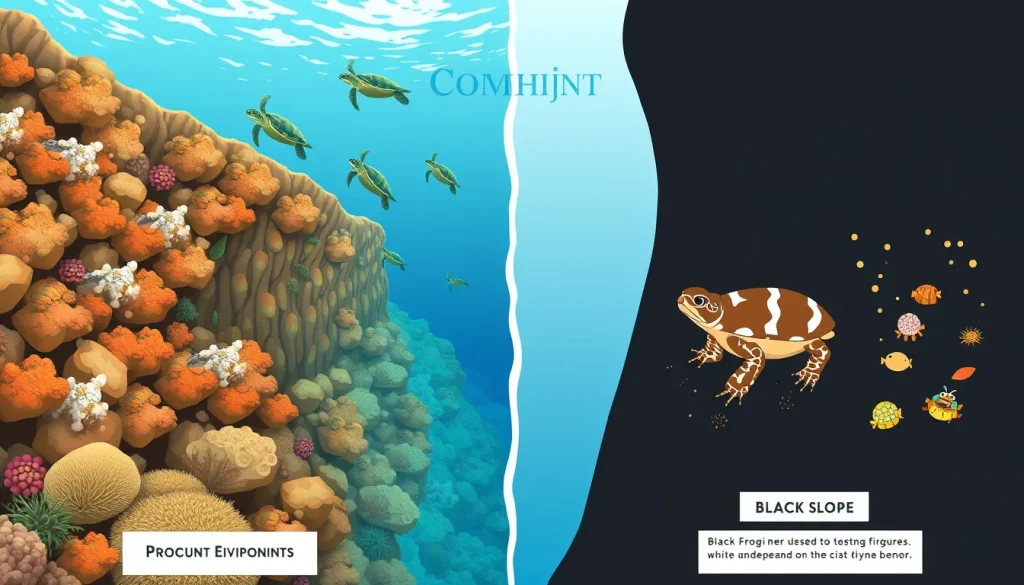
Bunaken and Lembeh are not competing versions of the same North Sulawesi dive trip. Bunaken National Marine Park is the region’s wall-and-reef destination: steep coral drop-offs, clear blue water and turtles. Lembeh Strait is the macro destination: black volcanic sand, slow diving and small, unusual animals. The two areas share the Manado airport gateway, but they reward different planning. The useful question is therefore not simply “which is better?” but whether you want one dive style, a split stay, or a yacht-based route that links both.
Two dive regions, one North Sulawesi gateway
Explore Indonesia’s sample 10-day itinerary begins and ends in Manado, then runs Manado–Bunaken–Lembeh–Manado. It also warns that divers underestimate the transfer between the two areas and forget to protect a no-fly gap before the flight home (Explore Indonesia). That is the practical frame for the whole comparison: the diving regions are close enough to combine, but they are not a single resort base with interchangeable day boats.
Bunaken National Marine Park was established in 1991 and covers more than 89,000 hectares across five islands in the Sulawesi Sea. Indoyachts describes its walls as plunging in places beyond 1,000 metres and notes that the region hosts more than 70% of the fish species found across the Indo-Western Pacific (Indoyachts). For a trip planner, the important point is scale: Bunaken is a marine park and an island name, not one dive site. Operators choose sites according to conditions, certification level and the day’s boat plan.
Lembeh is a strait, not a reef atoll. Two Fish Divers describes it as a different world of volcanic slopes and rare critters, and calls it the muck-diving capital of the planet (Two Fish Divers). That superlative is the operator’s language, but the contrast is accurate: Lembeh is where divers go slowly, looking at sand, rubble and small animals rather than cruising along a coral wall.
Bunaken: wall diving, clear water and reef scenery
Bunaken’s signature diving is vertical. Two Fish Divers describes 40-metre walls draped in soft coral, green turtles on many dives and visibility that often exceeds 30 metres (Two Fish Divers). Explore Indonesia adds that the diving is often drift-style along coral drop-offs that fall into open blue water (Explore Indonesia). This suits divers who enjoy big scenery, wide-angle photography, reef fish and the sensation of moving along a wall rather than hovering over a black-sand patch.
A Bunaken base is therefore a good fit for a trip where reef scenery is the main event. The source material describes resort-based stays at the Bunaken end, with boats used to reach sites in the marine park. Scubaversity’s combined trip also notes resort facilities such as pools and restaurants, which can matter for divers travelling with non-divers, though facilities vary by property and should be checked directly (Scubaversity).
The trade-off is specialisation. Bunaken can produce interesting small animals, but it is not the region’s muck-diving base. If your priority is frogfish, octopus, cuttlefish and patient macro photography, a Bunaken-only week may leave you wishing you had crossed to Lembeh.
Lembeh: muck diving, macro subjects and a slower rhythm
Lembeh’s diving is usually described through its substrate: black sand and volcanic slopes. Scubaversity lists frogfish, octopus and cuttlefish among the muck-diving highlights, and adds a Bangka day trip for soft-coral pinnacles and pygmy seahorses (Scubaversity). Two Fish Divers frames the appeal as hunting pygmy seahorses and other rare critters on volcanic black sand (Two Fish Divers). The common thread is not a single species list but a style: short distances, repeated dives, close observation and a guide who knows where small animals live.
A Lembeh base puts you in the strait rather than making a daily transfer from Bunaken. That matters because muck diving often works best when you can dive the same or similar sites more than once, at different times of day, and follow a guide’s local knowledge. The source operators describe resorts at the Lembeh end of a split stay; the exact house-reef or boat access depends on the property.
Lembeh is also the more obvious choice for photographers who want to spend a whole dive on one subject. The trade-off is that divers who want long coral walls and wide visibility may find the black-sand sites visually austere. That is not a defect; it is a different genre of diving.
Which base fits your trip?
The table below compares the main planning shapes. It is a decision aid, not a ranking: the right choice depends on your dive interests, time and tolerance for transfers.
| Base or trip shape | Best for | Trade-offs | Evidence note |
|---|---|---|---|
| Bunaken-area resort | Wall, reef and turtle diving; wide-angle; open blue water | Focused on one dive style; boat access to park sites | Two Fish describes walls, turtles and visibility; Explore Indonesia describes drift diving. |
| Lembeh Strait resort | Muck, macro, photography; slow, guide-led diving | Not a wall-and-reef-scenery base; site quality depends on guide knowledge | Scubaversity lists frogfish, octopus and cuttlefish; Two Fish describes muck diving. |
| Bunaken plus Lembeh split stay | Divers who want both styles in one trip | Middle transfer, two check-ins, less time in each area | Two Fish lists 4N/3N and 5N/5N packages; Scubaversity describes a two-resort trip. |
| Private yacht charter | A continuous route without resort changes | Charter cost and itinerary fit; not a land-based base | Indoyachts describes chartering between Bunaken and Lembeh. |
| Bangka day trip | Soft-coral pinnacles and pygmy seahorses | Day-trip availability depends on operator and sea conditions | Scubaversity includes Bangka in its combined trip. |
There is no universal best base. If you have one week and one priority, choose Bunaken for walls or Lembeh for macro. If you have seven to ten nights and want both, a split stay is the standard solution. Two Fish Divers presents 4 nights in Bunaken plus 3 in Lembeh, or 5 plus 5, while Explore Indonesia’s 10-day route gives each area real time rather than a rushed sampler (Two Fish Divers; Explore Indonesia). Those are common planning shapes, not rules.
Trip styles: focused, split, and yacht-based
A focused trip is the simplest. You pick one area, settle into one resort and spend your diving days learning a small number of sites well. Two Fish Divers notes that most divers do one or the other, and that is still a coherent choice if your holiday is short or your interest is narrow (Two Fish Divers). A focused Bunaken trip maximises wall and reef time; a focused Lembeh trip maximises muck and macro time.
A split stay is the usual way to combine both. The pattern is two resorts, one at each end, with a road-and-boat transfer in the middle. It gives you two different dive styles without another flight, but it also costs transfer time and two check-ins. The operator sample of 4N Bunaken plus 3N Lembeh is the compact version; 5N plus 5N is the more relaxed version (Two Fish Divers).
A private yacht charter changes the geometry. Indoyachts describes Bunaken and Lembeh as two opposite ends of the diving spectrum, a day’s sail apart, and presents a private charter as a way to move between them without changing resorts (Indoyachts). That can suit a group that values a continuous route, but it is a different product from a land-based split stay. The land transfer quoted by Two Fish is about two hours by road and boat between its own resorts; the yacht page’s “day’s sail” describes a vessel journey, not a resort shuttle (Two Fish Divers; Indoyachts).
Bangka is the third add-on. Scubaversity’s itinerary includes a Bangka day trip for soft-coral pinnacles and pygmy seahorses, which broadens a Bunaken-and-Lembeh trip without adding a third resort base (Scubaversity). Ask whether the day trip is included, weather-dependent or charged separately.
Travel logistics: Manado, transfers, and buffers
Manado is the practical arrival point. Explore Indonesia’s route starts and ends there, and both dive regions share the same airport gateway (Explore Indonesia). From Manado, land-based trips continue by road and boat to the Bunaken area or the Lembeh Strait. The middle transfer between Bunaken and Lembeh is the part to plan carefully: Two Fish Divers quotes about two hours by road and boat between its resorts at the two ends (Two Fish Divers). That is a useful sample, not a universal schedule; weather, traffic and boat departure times can change it.
Build in a buffer around the transfer. Explore Indonesia specifically warns that divers underestimate the transfer between the two areas (Explore Indonesia). A tight same-day changeover can leave little margin for a delayed boat or a late arrival, and it reduces the number of dives you can comfortably do on the moving day. If your priority is dive count, ask for a transfer plan that shows pickup time, boat time and the first dive slot at the next resort.
Protect the end of the trip as well. Explore Indonesia notes that divers forget to protect a proper no-fly gap before the flight home (Explore Indonesia). The exact interval depends on your diving profile and the policy you are following, so confirm it with your dive operator and insurer rather than relying on a generic number. Do not book a tight onward flight after the last Lembeh dive.
Conditions are another planning variable. Indoyachts describes a year-round season, and Scubaversity describes water at about 28–30°C all year (Indoyachts; Scubaversity). Those statements are useful for packing and expectation-setting, but they do not guarantee every site will be available on every date. Ask the operator about recent conditions, currents and any site closures before you commit.
Sample costs and what they do and do not tell you
Published package prices are useful for budgeting, but only if you read the unit and inclusions. The examples below come from Two Fish Divers’ Walls & Muck Safari page as retrieved on 6 November 2026. They are “from” prices per person and are tied to specific night splits and dives-per-day levels (Two Fish Divers).
| Package shape | Dives per day | Published from price |
|---|---|---|
| 4 nights Bunaken plus 3 nights Lembeh | 2 | IDR 17,275,000 per person |
| 4 nights Bunaken plus 3 nights Lembeh | 3 | IDR 21,775,000 per person |
| 5 nights Bunaken plus 5 nights Lembeh | 2 | IDR 24,735,000 per person |
The same page also mentions a free night dive with these packages at the time of retrieval (Two Fish Divers). It does not, in the supplied excerpt, establish every inclusion or the exact travel dates available. Treat the figures as an operator sample, not a market-wide benchmark. Ask whether transfers, marine-park fees, equipment rental, taxes and extra dives are included before comparing a quote with another operator.
What to confirm before traveling
This comparison relies on operator and itinerary pages retrieved on 6 November 2026, not on a live park office, port authority or airline timetable. Before booking, verify the operational details that matter to your dates:
- Current package price, room type, dive count and inclusions, including transfers, park fees, equipment and night dives.
- The middle transfer: pickup point, boat time, luggage handling and the realistic first dive at the second resort.
- The no-fly interval after your last dive, as required by your operator, insurer and airline.
- Your certification and experience level against the planned sites, especially for drift or wall diving.
- Whether a Bangka day trip is available and whether it is included or weather-dependent.
- Resort facilities for non-divers and any accessibility needs, since properties differ.
The sensible next step is to choose your primary dive style, then ask two operators for a day-by-day plan: one single-base option and one split-stay option. Compare the number of diving days, the middle transfer and the no-fly buffer before comparing the headline price. The operator pages cited here are a starting point for that conversation, not a live booking system.
FAQ
Can I combine Bunaken and Lembeh in one trip?
Yes. Operators run split stays with one resort in the Bunaken area and another on the Lembeh Strait side. Common samples include 4 nights Bunaken plus 3 nights Lembeh, or 5 plus 5, and a 10-day route gives each area more time. Confirm the middle transfer and no-fly buffer before booking.
Do I need to fly between Bunaken and Lembeh?
No. Land-based transfers typically continue by road and boat. One operator quotes about two hours by road and boat between its resorts at the two ends, while a private yacht itinerary may treat the passage as a day's sail.
Which area is better for macro photography?
Lembeh is the muck-diving base for frogfish, octopus, cuttlefish and patient macro work. Bunaken is the wall-and-reef base. Some combined trips add a Bangka day trip for soft-coral pinnacles and pygmy seahorses.
How many nights should I allow?
There is no single rule. A focused one-week trip can work for one area. For both, the sample split is 4 nights Bunaken plus 3 nights Lembeh, or 5 plus 5. A 10-day route gives each region real time and is a useful planning shape if you want both without rushing.