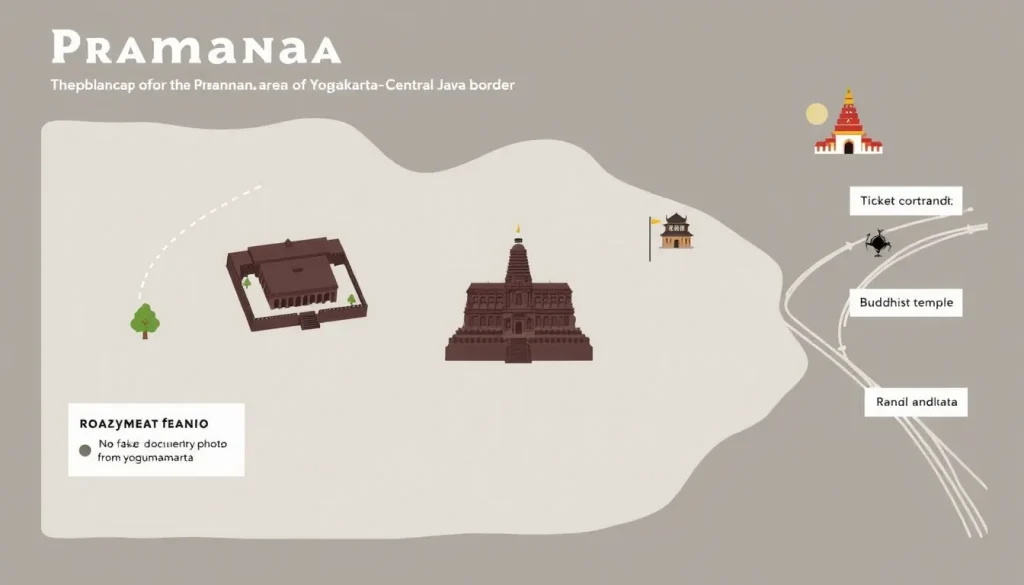
Prambanan is a temple complex, not a single monument. The main courtyard contains the principal Hindu shrines; around it lie smaller temples, the Buddhist temple of Sewu, and the Prambanan Museum. For planning purposes, most visitors should treat Prambanan as a half-day excursion from Yogyakarta: allow roughly two to three hours on site, start early, and confirm the day’s ticket rules and any maintenance closure before setting out. The site is on the Yogyakarta–Surakarta road, so it can also be reached from Solo, but Yogyakarta is the more common base.
What Prambanan is and where it sits
Prambanan Village is administratively split between Sleman Regency in Yogyakarta and Klaten Regency in Central Java; the complex is about 20 km from Yogyakarta city and 40 km from Surakarta (Solo), directly on the main Yogyakarta–Solo road, according to the Yogyakarta Tourism Portal. Lonely Planet describes it as Indonesia’s most important Hindu site, and the tourism portal calls it one of the largest temple complexes in Southeast Asia. The wider complex includes Sewu, described by Lonely Planet as Java’s second-largest Buddhist temple. That mix matters: visitors often come for the Hindu main temples but can also see Buddhist monuments and the museum in the same area. Prambanan and Borobudur are separate sites and should be planned as separate visits, even if they appear together in itineraries.
Opening hours, ticket service, and Monday access
The Yogyakarta Tourism Portal’s Prambanan Temple Tourism Park page, published in 2022, separates ticket service (06:30–17:00 WIB) from visiting service (07:00–17:30 WIB). A 2026 Prambanan guide gives the same broad pattern: ticketing from 06:30 WIB, with the area generally operating until around 17:30 WIB. WIB means Waktu Indonesia Barat, Western Indonesian Time (UTC+7), used in Java. Lonely Planet advises arriving at opening, given as 6:30am, to beat tour groups; the tourism portal’s distinction between ticket service and visiting hours is a reminder to check when the gate actually admits visitors on your date.
Monday is the key exception to check. The 2026 guide reports that Prambanan remains open on Mondays, but Zone 1, the main temple courtyard, closes for maintenance; other accessible areas can still be visited. Zone 1 is where the principal shrines stand, so a Monday visit may not suit a first-time visitor who wants the classic view. Maintenance schedules can change. Confirm Monday access and the status of Zone 1 through the official ticket channel before you commit to that day.
Tickets: what the figures mean
Ticket prices are the most volatile part of planning. The 2026 guide lists around IDR 400,000 for foreign adults and IDR 250,000 for foreign children. Lonely Planet’s 2025 guide gives US$25 for foreign adults. These are useful planning figures but not an official quote for every date. Kompas.com reported on 2 July 2026 that the official InJourney Destination site listed rates by visitor category and by weekday versus weekend, and that tickets could be bought online or directly. That means the price can depend on who is visiting and when. Check the current price for your date and category at the official purchase channel; do not rely on an old blog figure or a currency conversion alone.
What the ticket includes also needs checking. The 2026 guide says the ticket covers the Prambanan Temple Complex, Sewu Temple, Lumbung and Bubrah temples, and the Prambanan Museum. In practice, confirm the inclusions at the ticket desk or on the purchase page, especially if you are visiting on a Monday when part of the main courtyard may be closed. Ask whether the same ticket covers all the outlying temples on your date and whether any separate local guide fee applies.
How long to allow and how to sequence the visit
Most visitors should allow about two to three hours for the complex, according to the 2026 guide. That is a reasonable minimum for the main courtyard, a walk through the grounds, and a short museum stop. Add time if you want to see Sewu properly, visit Lumbung and Bubrah, or hire a guide. Lonely Planet suggests hiring a local guide inside the main entrance to see Sewu; a guide is not compulsory, but it helps if you want context rather than a quick photo stop.
A practical sequence is to go first to the main courtyard before tour groups build, then move outward to Sewu and the smaller temples, and finish at the museum if it is open and included. This is a planning suggestion, not a fixed route. Check the site map at the entrance and follow any barriers or staff instructions. If you want sunset photographs, Lonely Planet suggests the hilltop site of Kraton Ratu Boko, about 3 km from the main complex; treat that as a separate stop with its own opening hours and transport, not as part of the Prambanan ticket unless confirmed.
Getting there from Yogyakarta or Surakarta
From Yogyakarta, the 2026 guide lists four practical options: Grab or Gojek ride-hailing, Trans Jogja buses, the local train, and a private car. Ride-hailing is usually the simplest for a half-day visit because it takes you directly to the entrance, but return availability can vary; check the app before you leave or arrange a return time. Trans Jogja is the budget option, but you need to confirm the current route, stop, and walking distance to the gate. The local train is another listed option; confirm the station and onward transfer rather than assuming the temple is at the platform. A private car is useful if you plan to combine Prambanan with Ratu Boko or another stop.
From Surakarta (Solo), Prambanan is about 40 km away and reachable by the same main road. Travelers basing in Solo should budget for a longer road journey and confirm return transport, especially if visiting late in the day. There is no need to treat Yogyakarta and Solo as interchangeable bases: Yogyakarta is closer, while Solo may suit an itinerary that already includes the Surakarta area.
What to confirm before you travel
Before traveling, confirm these points with the responsible operator or official ticket page:
- Opening and last entry for your date, and whether ticket service starts before visitors are admitted.
- Monday status of Zone 1 and any other maintenance closure.
- Price for your visitor category and weekday or weekend, plus what the ticket includes.
- Current transport options and, for ride-hailing or private cars, how you will return.
- Guide availability at the main entrance and the fee.
- Weather and site conditions; carry rain protection if needed and wear footwear suitable for walking.
- Accessibility: ask about distances, steps, shade, and rest points if anyone in your group has mobility or heat-sensitivity needs.
This article draws on sources retrieved on 6 November 2026: a Lonely Planet guide dated 30 April 2025, Yogyakarta Tourism Portal pages from 2020 and 2022, a 2026 Prambanan guide, and a Kompas.com report dated 2 July 2026 that cites the official InJourney Destination site. The sources do not all reflect the same date. Prices, Monday closures, and transport details are the most likely to change, and no single official page has been verified here for every operational detail. Use the official purchase channel as the final check.
A sensible next step is to open the InJourney Destination ticket channel cited by the Kompas report, check the date and visitor category, then decide whether to base the visit in Yogyakarta or Solo and arrange transport. If the main courtyard is the priority, avoid a Monday unless the closure is confirmed as lifted; if Sewu and the museum matter, allow more than the two-to-three-hour minimum.
FAQ
Is Prambanan open every day?
A 2026 guide says it is open daily, and the tourism portal lists daily ticket and visiting hours. Monday access can differ because Zone 1 may close for maintenance, so confirm the date before traveling.
How much is entry to Prambanan?
A 2026 guide lists around IDR 400,000 for foreign adults and IDR 250,000 for foreign children; Lonely Planet lists US$25 for foreign adults. Kompas reported in July 2026 that official InJourney rates vary by visitor category and weekday or weekend, so confirm the price for your date.
How long should I spend at Prambanan?
Most visitors allow about two to three hours. Add time for Sewu, Lumbung, Bubrah, and the museum if you want to see them, and consider a guide for context.
Do I need a guide at Prambanan?
A guide is not required. Lonely Planet suggests hiring a local guide inside the main entrance, especially for visiting Sewu; confirm availability and the fee on site.