Indonesia is an archipelago of more than 17,000 islands, and that scale should shape your planning from the first page of notes. The main decision is not which single famous place to add next, but what trip shape you can realistically complete: how many bases, how much movement, and which transport legs you are willing to build a day around. This guide gives a decision path for independent international travelers. It covers route logic, timing, entry preparation, budgeting, local transport, and the essentials to confirm before you pay. It does not replace a detailed guide to a specific island, an operator timetable, or a live price quote.
Use it as a framework. You will still need to confirm your nationality’s entry rules, current transport schedules, and local conditions with the responsible authorities and operators.
The planning distinction: islands are not stops on a city metro
Indonesia’s size is the reason a simple list of highlights can fail as an itinerary. A route that looks short on a map may involve a flight, a road transfer, a port wait, and a boat. One transport guide notes that even a short hop can take most of a day once the drive to the port, the wait, and the transfer at the other end are included. That is the practical difference between main travel time and total travel time.
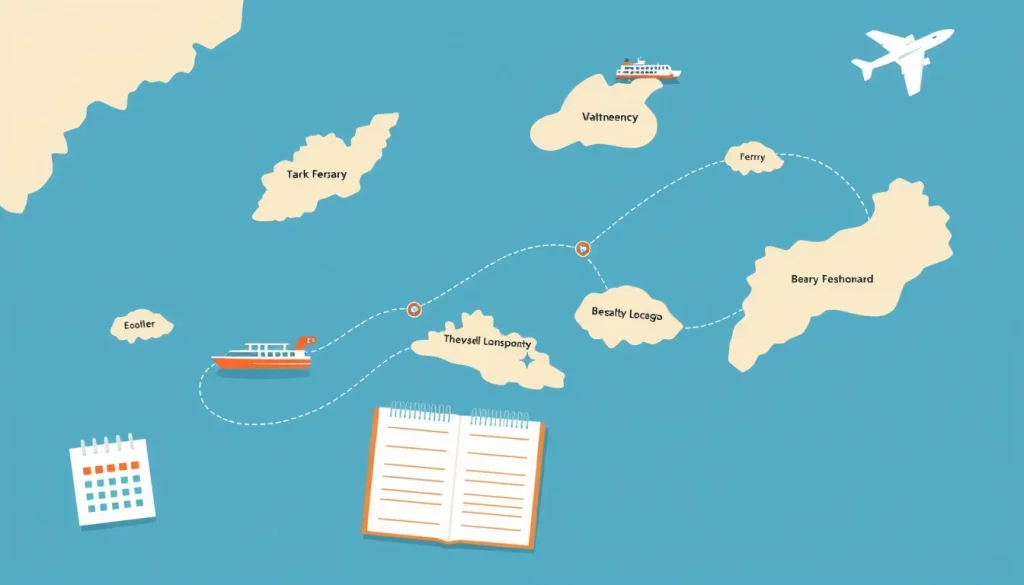
A typical first-trip example might include a train across Java, a ferry to Bali, a fast boat to the Gilis, a domestic flight to Labuan Bajo, and a wooden boat through Komodo. That is a real multi-region trip, but it is not a sensible checklist for a one-week holiday. Treat each move as a planning unit, and count nights rather than attractions. If a day contains two long legs, it is probably not a travel day; it is a transit day with no useful sightseeing window.
Choose a trip shape before choosing hotels
Trip shape means the broad logic of your route. It helps you reject options early, before you spend hours comparing hotels that do not fit the sequence. The table below is a planning comparison, not a ranking. Each style can work well if the time, budget, and comfort level match the traveler.
| Trip shape | Example route logic | Suits | Watch-outs |
|---|---|---|---|
| Single-region slow trip | One island or province, with two bases and day trips from each. | Travelers with about a week or less, or anyone who prefers depth over coverage. | It is easy to underestimate internal travel; confirm the road and boat connections between bases. |
| Java by rail and city bases | Use trains between city bases, then take local transport for day visits. | Travelers interested in culture, food, and city-to-city movement without constant flights. | City transfer time, heat, and station logistics can still consume a half-day. |
| Bali and Nusa Tenggara link | Combine Bali with Lombok, the Gilis, or Labuan Bajo and Komodo by ferry, fast boat, and flight. | Travelers with around two weeks and a tolerance for inter-island logistics. | Multiple boat and flight legs increase weather risk and check-in time; avoid tight connections. |
| North Sulawesi marine focus | Fly to Manado, use a mainland base, and transfer to Bunaken or another coastal area for diving and snorkeling. | Travelers who want a slower marine trip rather than a multi-island circuit. | Flight connections, sea conditions, and boat schedules matter more than a long list of sights. |
If you are unsure, choose fewer bases. A trip with two well-connected bases usually gives a better sense of a place than four bases linked by half-day transfers. The right route is the one whose transport legs you can explain without hoping that something will work out later.
Timing: regional seasons, holidays, and transfer days
Indonesia is equatorial, and wet and dry patterns vary by region, altitude, and marine area. There is no single national best month that applies equally to Java, Bali, North Sulawesi, and the thousands of islands between them. Check rainfall, sea conditions, and access for the exact route you are planning rather than relying on a national average. A first-timer guide can help you build general awareness of timing and health, but it cannot decide whether a specific boat will run or a specific trail will be open.
Holidays also matter. National holidays, local festivals, school breaks, and long weekends can affect transport seats and accommodation availability. If your trip depends on a particular ferry, flight, or guided activity, confirm the operating calendar with the operator before you build the rest of the itinerary. Build a buffer before your international departure and after any long inter-island leg. A missed connection is stressful anywhere; on an archipelago route, it can reshape the whole trip.
For daily rhythm, start transfer days early and avoid scheduling a must-do activity on the same day as a long flight or ferry. The most useful planning habit is to mark each day as either a base day or a transfer day. Base days can hold activities. Transfer days should hold only the move, the check-in, and a simple meal.
Arrival and entry: prepare the paperwork, then the first night
The practical arrival sequence is straightforward: confirm entry eligibility, complete any required declaration, arrange the first transfer, and reach a first-night base without pressure. Travel-planning sources describe an Electronic Visa on Arrival, often shortened to e-VOA, and an online customs declaration as common formalities for some travelers. Do not assume either applies to you. Eligibility depends on nationality, purpose, and length of stay, and the rules can change. Confirm with Indonesian immigration and customs, and check your airline’s document requirements before departure.
Save copies of key documents offline and keep the address of your first accommodation available. If you land late, a hotel near the airport can be a better first night than a long road transfer to a distant base. For airport transfers, use an official counter, a licensed driver, or a recognized ride-hailing app rather than an unmarked offer. This is general good practice, not a guarantee that every airport works the same way.
Costs: budget by category and by leg
Indonesia uses the Indonesian rupiah, usually written as IDR. Rather than relying on a single daily average, build a budget from categories: international flights, domestic transport, accommodation, food, activities and permits, local transfers, connectivity, and a contingency fund. Costs vary by island, season, comfort level, and whether you are traveling alone or sharing a room or vehicle. A price that is normal in one base may be unrealistic in a remote area or during a holiday peak.
Quotes should state the unit and scope. Is a boat ticket one-way or return? Is a driver quote per vehicle, per day, or per person? Is a room rate per night and inclusive of tax? For long routes, the hidden cost is often not the ticket but the extra night, meal, or missed activity caused by a delayed connection. Add a realistic buffer rather than assuming every leg will run to the minute.
Payment acceptance also varies. Cards may work in many hotels and urban businesses, but smaller operators and remote areas may rely on cash or bank transfer. Carry a backup payment method and confirm the expected method before a costly transfer or activity. Treat any sample price as a dated observation for a specific service, not as a national standard.
Getting around: match the mode to the route
Indonesia’s transport mix includes domestic flights, ferries and fast boats, long-distance PELNI ferries, trains in Java, private drivers, ride-hailing apps such as Grab and Gojek, and scooter rental. Each mode answers a different problem. Flights cover long distances between major hubs. Ferries and fast boats connect islands, but weather and port conditions can affect them. Trains are useful for city-to-city movement in Java. Drivers and ride-hailing are useful for shorter road legs, while scooters require confidence, licensing, and insurance checks.
Book through a clear operator channel or a reputable agent, and reconfirm critical legs before travel. Keep the main travel time separate from the total time: a 45-minute flight may still require two hours at the airport, a transfer to the city, and a check-in. For long inter-island routes, PELNI ferries appear in independent travel planning, but schedules and conditions should be confirmed with the operator. Do not treat a guidebook mention as a live timetable.
In Java, trains can reduce reliance on road transfers between city bases. In North Sulawesi, the common planning logic is different: arrive by air in Manado, then use road and boat connections to coastal or island bases such as Bunaken. Confirm sea conditions and onward boat schedules locally, and leave room for a weather delay if the marine part of the trip is the main purpose.
Regional context: Java and North Sulawesi, two planning logics
Java shows how a dense, well-connected island can be sequenced by rail and city bases. Yogyakarta is a useful name to clarify because it can refer to the city and to the wider special region. When a booking says Yogyakarta, check whether it means the city center, the airport area, or a district outside the city. Java is also an island, not a single destination, so a Java route needs a decision about which city bases and cultural sites you actually want rather than a vague plan to see Java.
North Sulawesi shows a different logic. It is a province on the northern arm of Sulawesi, with Manado as its capital and usual air gateway. Bunaken is an island and marine park offshore, not a city or province. A North Sulawesi trip is often built around a Manado arrival, a mainland base, and a transfer to a marine area for diving or snorkeling. That shape rewards patience with boat schedules and weather; it does not suit a traveler who wants to change location every day.
These two examples are not a summary of all Indonesia. They simply show why route planning must follow regional conditions. A Java itinerary can be rail-led and city-based. A North Sulawesi itinerary can be flight-led, road-connected, and marine-dependent. The same country contains both logics, and many others.
A workable planning sequence
Rough Guides’ planning framework begins with setting parameters and building a wish-list before booking the basics, and it suggests starting key planning about six months before travel. A practical sequence for most independent trips looks like this:
- Set dates and count usable nights. Subtract arrival and departure days, then subtract any day that cannot hold an activity.
- Choose one trip shape and two or three bases. Write every move as a transport leg with a start point and end point.
- Check entry and health requirements. Use official immigration, customs, and health sources, plus your airline, rather than relying on a travel article.
- Draft the day-by-day route. If one day has two long legs, cut one and add a night elsewhere.
- Get quotes for the major legs. Record what each quote includes and whether it is per person, per room, or per vehicle.
- Book fixed essentials only. That usually means international flights, the first and last nights, critical domestic flights, and any permit or activity that genuinely sells out.
- Prepare local essentials. Offline maps, translation tools, power adapters, medication, document copies, and a backup payment method are more useful than a long list of optional apps.
Leave the middle of the trip as flexible as your comfort allows. In an archipelago, a little slack is not wasted time; it is the thing that prevents a delayed boat from ruining the next booking.
Local essentials: money, language, etiquette, health, and connectivity
Money. Keep a mix of payment methods. Cards are useful in many urban businesses, but cash remains important for small warungs, local transport, and remote areas. Withdraw from reputable bank ATMs where possible and avoid carrying all your cash in one place.
Language. Indonesian is the national language, and local languages are also widely used. Simple phrases help: terima kasih means thank you, permisi means excuse me, and berapa harganya? means how much is it? English is common in many tourism areas but not universal, so save offline translations for addresses and dietary questions.
Etiquette. Dress modestly at religious sites, remove shoes where required, and ask before photographing people or ceremonies. Customs vary between communities and regions, so observe local cues rather than treating one island’s practice as a national rule. Rough Guides’ first-timer tips cover cultural etiquette, health, money, and safety as general preparation topics.
Health and safety. Arrange travel insurance that covers the activities you plan, and discuss vaccines, medication, and malaria or dengue precautions with a qualified clinician. Food and water safety varies by place and vendor. Marine activities require honest assessment of your swimming, diving, and sea-condition comfort. Do not assume a boat, trail, or dive site is suitable just because it is advertised.
Connectivity. Mobile data is useful for ride-hailing, translation, maps, and confirming bookings. Arrange a local SIM or eSIM according to your device compatibility and check coverage for remote areas. Power supply and plug types can differ from home, so bring the correct adapter. None of these details should be left to the airport arrival desk if you rely on your phone for transport.
Checks before you book
Several details are too volatile for a general guide to settle. Confirm them with the responsible source, not with a search snippet or an undated blog post.
- Visa, e-VOA, customs, and health rules: check Indonesian immigration and customs, your airline, and your own government’s travel advice.
- Domestic flights, ferries, and fast boats: check the operator or a reputable booking platform for schedule, port, check-in time, and cancellation policy.
- Park permits and access: check the park authority or licensed operator for current rules, closures, and fees.
- Weather and marine conditions: check official meteorological and marine sources, and ask operators how conditions affect their route.
- Prices and inclusions: get a written quote or booking confirmation that states currency, unit, date, and what is included.
- Accessibility, dietary needs, and medical questions: ask the venue or operator directly; do not rely on a general claim that something is accessible or allergy-safe.
The sources used here are general travel-planning guides, not official timetables, legal advice, or live price checks. Treat any detail that is not confirmed by the responsible authority or operator as unverified until you check it.
Next step: test your route on paper
Write your itinerary as a simple table of nights and transport legs. For each leg, name the departure point, arrival point, mode, approximate total time including transfers, and the backup if it is cancelled. If you cannot explain how you get from one base to the next, remove one base. Then confirm your entry requirements and one critical transport leg before booking the rest. That single exercise will prevent more problems than any list of “must-see” places.
FAQ
How many islands should I visit in one Indonesia trip?
For most independent trips, two or three bases are more realistic than counting islands. Transport legs can consume most of a day, so choose fewer bases and leave room for delays.
Do I need an e-VOA for Indonesia?
Not necessarily. The e-VOA is one entry route mentioned in travel-planning material, but eligibility depends on nationality, purpose, and length of stay. Confirm with Indonesian immigration and your airline before travel.
What is the best way to get around Java?
Trains are a useful city-to-city option in Java, alongside drivers and ride-hailing. Confirm schedules, stations, and transfer times with the operator before building a tight itinerary.
Do I need to rent a scooter in Indonesia?
No. Flights, trains, ferries, drivers, and ride-hailing apps cover many routes. Rent a scooter only if you are licensed, insured, confident, and aware of local road conditions.