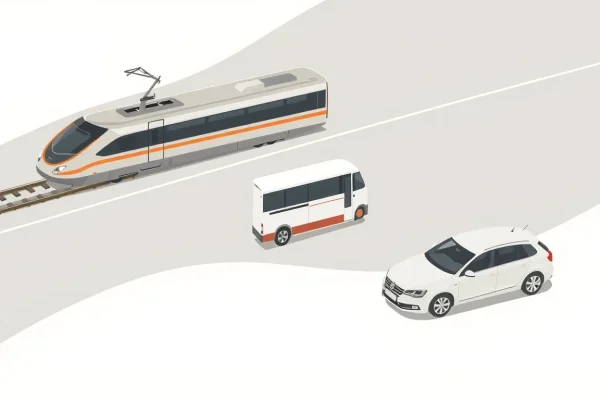
Indonesia is an archipelago, and that single fact shapes nearly every transport decision. Lonely Planet’s transport guide describes a country measuring nearly 5,000km from east to west, with more than 17,000 islands. For a visitor, the useful question is not “What is the best way to get around Indonesia?” but “What is the right mode for this leg?”
This article is a planning overview for international travelers. It covers the main choices between flights, trains, ferries, buses, private vehicles, and city transport, and it explains how to build a route without relying on a single mode. It does not replace operator timetables or live booking systems. For any specific journey, confirm schedules, ports, stations, and ticket conditions with the operator before you commit.
Start with the shape of the journey, not the mode
The most useful planning distinction is between three kinds of movement: a city hop, a land leg, and an island change. A city hop is a short trip within a city or to a nearby gateway, where a ride-hailing app or taxi may be enough. A land leg is movement on the same island, where a train, bus, or private car can work. An island change is a different problem: it usually requires a flight or a sea crossing, and it deserves its own travel day.
Simply Indonesia’s transport guide puts the point directly: Indonesia is an archipelago, not a single metro map, and transport should be matched to the island, luggage, weather, arrival time, and tolerance for waiting. AsiaVela adds the hard constraint: no bridge links Java with Bali, Lombok, or the islands further east, so a long jump is a flight or a sea crossing. That is why a single “best transport” answer fails.
The main choices at a glance
The table below summarizes the practical trade-offs. Each mode is developed in more detail in the sections that follow.
| Mode | Best for | Main trade-offs | What to confirm |
|---|---|---|---|
| Flights | Long inter-island legs and time-sensitive routes | Airport transfers, baggage rules, delays, and total door-to-door time | Airport and terminal, baggage allowance, transfer options |
| Trains | Java corridors where the station pair lines up | Limited outside Java; station transfers; fixed departure times | Station, ticket conditions, passport or ID requirements |
| Ferries and boats | Sea crossings that are part of the route | Longer journeys, weather, port logistics, and sea conditions | Departure port, ticket collection, operator, weather policy |
| Buses and private vehicles | Cheap land movement and remote areas | Road time, traffic, comfort, and unclear pickup points | Vehicle type, driver scope, waiting time, route |
| Ride-hailing and taxis | City hops and short transfers | Availability, traffic, and designated pickup zones | App availability, fare method, pickup point |
Flights: the practical default for crossing islands
For most visitors, flights are the sane default between major islands. Lonely Planet recommends flying budget carriers for speed, and Simply Indonesia treats flights as the practical choice between big islands. That does not mean every flight is cheap or convenient. It means the alternative may be a multi-day overland-and-sea chain.
Use flights when a land-and-sea route would consume a full day or more, when luggage makes ferry travel awkward, or when fixed dates matter. Do not treat a flight as automatically better for a short hop where a road transfer or boat crossing already fits. The key is to count the whole journey: the airport transfer, check-in, baggage collection, and the transfer at the other end. A short flight can still occupy half a day.
Before booking, confirm the airport and terminal, the baggage allowance, and how you will get from the airport to your accommodation. Budget carriers may have different rules from full-service airlines. The sources used here are general guides, not live booking systems, so confirm current details with the airline or a reputable agent.
Trains: Java’s corridor and the Whoosh line
Java is the exception on land. Lonely Planet notes that Java has Indonesia’s dense railway network, and that trains cross Java in comfort past volcanic scenery. AsiaVela adds that the Jakarta–Bandung corridor has the Whoosh high-speed line. This makes rail a strong option when your origin and destination are both on Java and the station pair lines up with your itinerary.
Rail is not a nationwide solution. Outside Java, trains are not a general inter-island option, and even within Java you should not assume that a city name corresponds to a single station. Choose the station pair, not just the city pair. Treat the station-to-accommodation leg as part of the trip, especially if you arrive late or carry luggage.
Book through the operator or a reputable booking channel, and confirm ticket conditions before travel. The sources used here describe the broad network rather than current timetables, so check departure times, station names, and any passport or ID requirements with the operator. The Whoosh line is specifically useful for the Jakarta–Bandung route; it is not a substitute for a Java-wide rail plan.
Ferries and boats: when the sea crossing is part of the route
Ferries are not a fallback for travelers who cannot afford a flight. For many islands, they are the route. Lonely Planet highlights Pelni ferries as a way to reach islands by sea. Simply Indonesia advises taking ferries when the sea crossing is genuinely part of the itinerary, rather than building the cheapest possible chain of connections. InterInformation notes that inter-island options include ferries, speedboats, and shuttle services.
Ferry planning is port planning. Confirm the departure port, the ticket collection point, whether the service carries passengers only or vehicles, and how long the crossing is scheduled to take. Then add time for getting to the port and from the arrival port to your accommodation. Sea conditions can change, so build in slack if the ferry is a critical connection. Do not treat a ferry as a bus on water.
Speedboats can shorten some crossings, but they are not universal and they are not automatically safer or more reliable. Confirm the operator, the meeting point, the weather policy, and what safety equipment is provided. If a boat transfer is part of a diving or island package, ask the operator whether the crossing is included or must be arranged separately.
Buses, private vehicles, and city transport
On land, buses are often the cheapest way to move across the archipelago. Lonely Planet notes that buses are cheap across the archipelago, and that renting a vehicle can help in remote areas. In cities, Simply Indonesia lists Grab, Gojek, Bluebird, and local taxis as common options for city hops.
Gojek and Grab are app-based ride-hailing services; Bluebird is a taxi operator. They are not interchangeable everywhere. App availability can vary by city or neighborhood, and airports and stations may have designated pickup zones. Confirm the fare method and the pickup point before you get in. For late arrivals, it is worth deciding in advance whether you will use an app, a taxi queue, or a pre-arranged transfer.
A private car with a driver can make sense for a day trip, a remote area, or a group with luggage. Agree on the scope of the hire before departure: the route, waiting time, fuel, parking, and whether the driver stays with you. A rented scooter is sometimes presented as an easy solution, but treat it as a legal and safety decision, not a default. Confirm licensing, insurance, helmet rules, and local traffic rules with reliable local sources before you ride.
Regional context: Java and North Sulawesi show different transport logics
Java rewards rail planning. Its dense network, plus the Whoosh Jakarta–Bandung line, means that a Java itinerary can be built around train corridors rather than a chain of flights. That does not remove the need for transfers. A train arrival may still require a taxi or ride-hailing leg, and a tight connection between a train and a flight is risky unless you have allowed a buffer.
North Sulawesi shows a different logic. Manado is the main air gateway for the province, and trips to Bunaken (an island and marine park off Manado) or the Lembeh Strait area usually combine a road transfer with a boat crossing. There is no Java-style rail option for those final legs. Confirm the boat operator, the meeting point, and sea conditions rather than assuming that a flight to Manado solves the whole journey.
These two examples are not a complete regional survey. They show why a national guide must be adapted. A route that works smoothly in Java may be impossible or impractical in a province where the final connection depends on a small boat. The common error is to assume that one region’s transport pattern applies everywhere.
Build a route: a simple decision sequence
- Mark your fixed dates and must-see places on a map. Group places by island before you compare transport options.
- Count the island changes. AsiaVela suggests planning one travel day for each island change. Treat that as a planning rule, not a guarantee.
- Choose a mode for each leg. Use flights for long inter-island legs, trains where Java’s station pairs work, ferries where the sea crossing fits the route, buses or private cars for land movement, and apps or taxis for city hops.
- Write the total door-to-door time, not just the scheduled duration. Include transfers, check-in, ticket collection, and waiting.
- Book critical long legs and your first and last nights early. Leave a buffer before an international flight or a critical ferry.
- Confirm volatile details shortly before travel: schedules, ports, stations, baggage rules, and weather-related changes.
As a reality check, AsiaVela suggests that on a two-week trip, travelers should expect something like two or three domestic flights and one or two Java train legs. That is a more realistic shape than trying to cover six islands in the same period.
Money, comfort, and the cost of cheap connections
Do not overbuild a trip around the cheapest possible chain of connections. Simply Indonesia warns against that approach, and InterInformation notes that early planning matters and that paying extra for a reputable provider can be worth it. A cheap ferry that arrives at night, or a flight with a long transfer, can cost more in time, taxi fares, and stress than it saves.
This guide does not provide price ranges because costs vary by route, season, operator, and booking channel. Instead, compare the total cost of each option: ticket price, transfer cost, luggage fees, meals, and an overnight stay if the connection forces one. Comfort matters too. Luggage space on buses and boats, heat, and accessibility can change the practical value of a cheaper ticket.
If you have accessibility needs, confirm directly with the operator. Do not assume that a station, port, or boat is step-free or that assistance is available. General transport guides cannot guarantee the facilities of a specific service.
What to confirm before you travel
- Schedules and operators: confirm the current departure time, route, and operator for every critical leg.
- Ports, stations, and airports: check the exact name and location, not just the city. Some cities have more than one terminal or station.
- Transfers: decide how you will get from the terminal to your accommodation, especially on late arrivals.
- Baggage and tickets: confirm allowances, check-in rules, and whether tickets must be collected in person.
- Weather and sea conditions: for ferries and boats, ask the operator about delays, cancellations, and alternative arrangements.
- Entry and legal requirements: use official government sources for visa and entry rules; do not rely on a general transport guide.
- Local transport rules: if you plan to drive or ride a scooter, confirm licensing, insurance, and helmet requirements locally.
The sources used here are general transport guides updated in 2026, not live timetables or booking systems. They are useful for understanding the shape of the network, but they cannot confirm that a specific ferry will run tomorrow or that a particular train has seats. Confirm operational details with the responsible operator or official tourism authority before you act.
Next steps
Open a map and list your island changes before you book anything. For each change, write one primary mode and one realistic backup. Then move to the supporting guide for that leg: Java rail routes, ferry ports and tickets, airport transfers, city transport, or a regional plan such as North Sulawesi. If a leg has no clear operator or connection, redesign the route rather than adding a tight transfer. The most reliable Indonesian itinerary is usually the one that respects the distance between islands.
FAQ
Can I rely on trains to travel across Indonesia?
Not nationwide. Java has the dense rail network and the Whoosh Jakarta–Bandung line; outside Java, trains are not a general inter-island solution. Confirm any specific route with the operator.
Should I fly or take a ferry between islands?
Use flights for long inter-island legs and ferries where the sea crossing fits the route and you have time for weather and port transfers. There is no single best mode for every crossing.
How long should I allow for an island change?
A useful rule of thumb is one travel day per island change, including transfers. This is planning guidance, not a guarantee; confirm schedules and total door-to-door time.
Is ride-hailing available everywhere?
Gojek and Grab are common in cities, but availability and pickup rules vary. Confirm in the app and use designated pickup points at airports and stations.