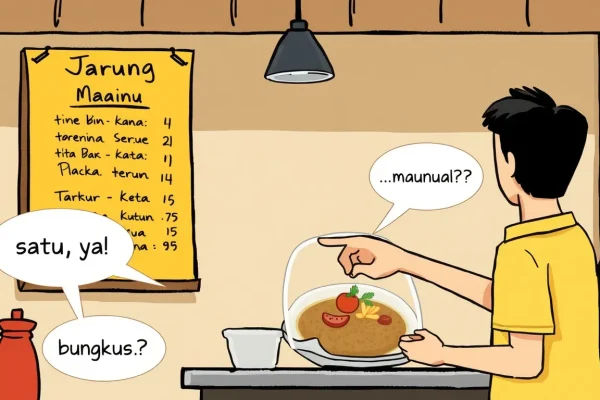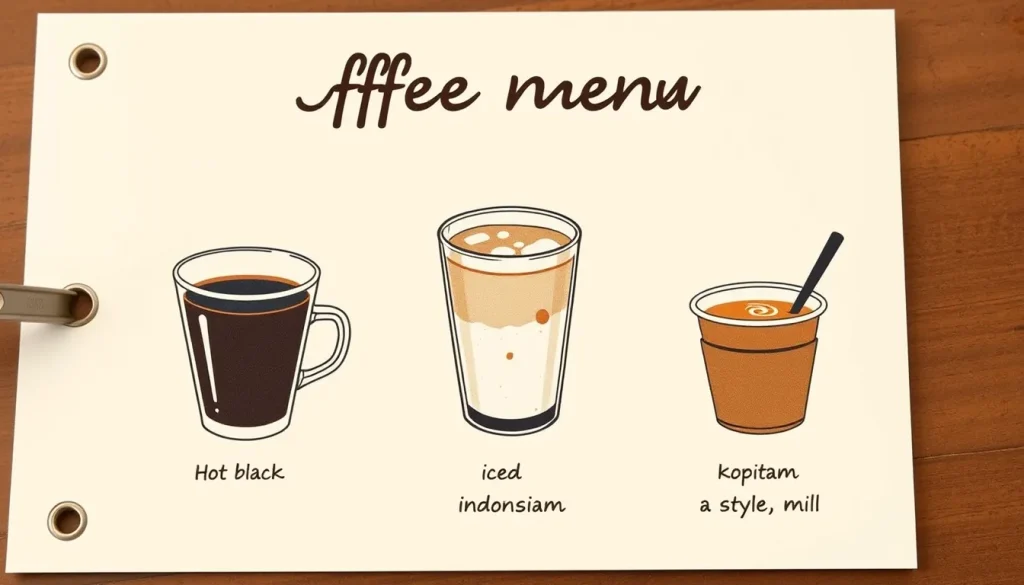
Coffee in Indonesia is not ordered through one national menu. A small warung (family-run stall or shop) may have a handwritten list or no printed menu at all, while a city café and a kopitiam (coffee shop in the Hokkien/Malay tradition) can use different words for similar drinks [2][4]. The practical method is to learn four choices: temperature, milk, black or not, and sweetness. The core terms are kopi (coffee), panas (hot), es (iced), susu (milk), hitam (black), and the sweetness phrases kurang manis (less sweet) and tanpa gula (without sugar) [1].
That short vocabulary handles most orders, but it is not a complete dictionary. Indonesian coffee names describe preparation, serving temperature, and local shop conventions. The same words can mean slightly different things in a warung, a specialty café, and a kopitiam. Use the terms as a starting point, then ask one or two questions when the menu is unclear.
Start with four decisions
Before searching for a specific drink name, decide what you actually want. First, hot or iced: kopi panas is hot coffee and es kopi is iced coffee [1]. Second, black or with milk: kopi hitam is black coffee, while es kopi susu is iced coffee with milk [1]. Third, sweet or less sweet: kurang manis asks for less sweetness and tanpa gula asks for no sugar [1]. Fourth, ask what is included if you have dietary needs or want to avoid surprise ingredients.
This order of decisions matters because many coffee names combine these features. A sweet iced milk coffee is not simply a hot black coffee with ice added. In the modern es kopi susu, for example, the drink is typically made with espresso, condensed milk, and ice [1]. If you only say kopi, you may get something much sweeter or smaller than expected.
Core terms at a glance
| Term | Meaning | What it tells you |
|---|---|---|
| Kopi | Coffee | The base word; ask what style is available |
| Kopi panas | Hot coffee | Hot serving [1] |
| Es kopi | Iced coffee | Iced serving [1] |
| Es kopi susu | Iced coffee with milk | Modern classic, often espresso, condensed milk, and ice [1] |
| Kopi hitam | Black coffee | No milk [1] |
| Kopi tubruk | Traditional ground coffee in hot water | Strong and sweet [1] |
| Tanpa gula | Without sugar | Asks to omit sugar [1] |
| Kurang manis | Less sweet | A relative request, not an exact measure [1] |
| Susu | Milk | Appears in es kopi susu [1] |
| Gula | Sugar | Appears in tanpa gula [1] |
| Manis | Sweet | Appears in kurang manis [1] |
Sweet by default
One of the most useful expectations to set is that Indonesian coffee is often served sweet. Fun with Indonesian states plainly that coffee is served sweet and gives tanpa gula or kurang manis as the phrases to use [1]. A Bali-oriented drinks guide makes a similar practical point: if you want to control sugar or ice, ask whether they are included [3]. This is not a warning that every cup is dessert-sweet; it is a reminder that sweetness is often part of the default recipe rather than something you add at the table.
Be precise about what you are asking. Tanpa gula means without sugar, but it does not automatically remove sweetened condensed milk from a drink. Es kopi susu commonly contains condensed milk [1], and kopitiam-style drinks may include evaporated milk or other sweetened ingredients [4]. If you need no dairy or no added sweetener at all, say so directly and ask the seller to confirm the ingredients. Kurang manis is a relative request; one stall’s less sweet may still be sweeter than you expect.
Traditional and modern drinks
Two names are worth knowing because they point to different coffee habits. Kopi tubruk is the traditional preparation: ground coffee placed in hot water, strong and sweet [1]. It is a simple, unfussy drink associated with everyday coffee rather than café-style service. Es kopi susu is the modern classic: espresso with condensed milk and ice [1]. The two names do not describe the same texture or sweetness, so do not use them interchangeably.
Indonesia is one of the world’s major coffee-producing countries, and its specialty coffee scene has grown in recent years [1][2]. That growth means you may see pour-over, cold brew, and espresso-based drinks in cities. It does not mean the older warung vocabulary has disappeared. A visitor may move from a specialty café with English menu descriptions to a warung with a handwritten menu or no menu at all in the same day [2].
Kopitiam terms: kopi o, kopi c, kopi peng
Kopitiam menus add another layer. A 2026 detikFood explanation notes that names such as kopi o, kopi c, and kopi peng come from Hokkien and Malay adaptations and can be confusing because they encode sugar, evaporated milk, and butter rather than modern café-style categories [4]. The term explained in detail there is kopi o: black coffee brewed from ground coffee, usually robusta or liberika, stirred with sugar and served without milk, giving a bitter, lightly sweet cup [4].
In the wider kopitiam vocabulary, kopi c is often associated with evaporated milk, and kopi peng with an iced serving. Treat those as useful expectations, not guarantees. Recipes and local usage vary by shop, and the same menu may use different defaults for sugar and milk. If the distinction matters, point to the menu and ask what the drink contains.
A simple ordering sequence
At a warung or small café, a short sequence is usually enough. Start with the drink and temperature, add the milk or black instruction, then adjust sweetness. Use a complete phrase rather than isolated words so the seller can follow your intention:
- Hot black coffee, no sugar: Kopi hitam panas, tanpa gula.
- Iced coffee with milk, less sweet: Es kopi susu, kurang manis.
- Traditional coffee, less sweet: Kopi tubruk, kurang manis.
- If the menu is unclear: Ada kopi apa saja? (What coffees do you have?)
These are practical model orders, not a formal script. In a busy shop, it is normal to point at the menu or a neighbouring glass and ask for the same thing. If you need to confirm ice, milk, or sugar, ask before the drink is made. A seller may also ask you questions such as how sweet you want it; answer with kurang manis or tanpa gula [1].
Regional and setting differences
Do not assume one island or one city speaks for all of Indonesia. Coffee names vary by setting: a family warung, a tourist-area café, a specialty roastery, and a kopitiam are different institutions with different menus [2][4]. In Bali, for example, a general drinks guide separates everyday coffee and sweet iced tea from fresh coconut, herbal jamu, and alcoholic drinks, and advises asking about sugar and ice when you want control [3]. That is a useful habit anywhere.
Language also changes. In cities, café staff may use English or Italian terms such as espresso, americano, or latte. In a warung, simpler Indonesian words are more likely to be understood. In a kopitiam, the Hokkien/Malay-derived shorthand may be the local norm [4]. The safest approach is to use the simplest word for what you want, then adjust with panas, es, susu, hitam, kurang manis, or tanpa gula [1].
What to confirm before you order
Three details are worth confirming when they matter to you. First, sugar: ask whether sugar or sweetened milk is already included, not only whether sugar can be added. Second, ice: an iced drink may be served very cold and full of ice; ask if you need it adjusted. Third, milk: es kopi susu commonly uses condensed milk [1], and kopitiam drinks may use evaporated milk [4]. If you have a dairy allergy or another dietary restriction, ask staff to check the actual ingredients; a menu term alone is not an allergy guarantee.
The guidance here comes from a small set of sources retrieved on 6 November 2026. Some carry 2026 publication or update dates; others do not. They describe common patterns, not an official national coffee standard, and they cannot confirm what a particular shop is serving today. Menus, recipes, and language use vary. When a drink name is unfamiliar, ask one direct question about ingredients or preparation before ordering.
FAQ
What does kopi mean in Indonesian?
Kopi means coffee. Add panas for hot or es for iced; kopi hitam is black coffee [1].
How do I ask for coffee without sugar?
Say tanpa gula. For less sweetness, say kurang manis. Ask about sweetened milk too, because condensed milk is common in es kopi susu [1].
What is kopi tubruk?
Kopi tubruk is traditional coffee made by placing ground coffee in hot water. It is described as strong and sweet [1].