Indonesia’s language landscape is often described as one of the most diverse in the world. The national language, Bahasa Indonesia, is used for official communication, schooling and broadcast media across the country. For travellers, the practical question is not only which language is official, but which language you will actually hear—and what to learn before you arrive.
Start with Bahasa Indonesia. It is the shared language for people from different backgrounds and the most useful choice for transport, hotels, menus, signs and basic transactions. English is not widely spoken as a general rule, but it is often understood in major cities and established tourist destinations. Regional and community languages remain important, especially outside tourist centres and in everyday local life.
Bahasa Indonesia: the national language and the visitor’s default
Bahasa Indonesia is the national and official language of Indonesia. Indonesia Travel’s language overview explains that it is used for official communication, taught in schools and used in broadcast and digital media. The same source notes that most Indonesians also have their own ethnic language or dialect, with Javanese and Sundanese the most widely spoken. For many people, Indonesian is the shared public language rather than the first language of family and community.
The name needs a small unpacking. Bahasa means “language” in Indonesian, so Bahasa Indonesia literally means “Indonesian language.” In English, “Indonesian” is enough. In Indonesia, you may hear the national language called Bahasa Indonesia, Bahasa, or simply Indonesian depending on the speaker and setting. It is closely related to Malay: the reference overview of Indonesia’s languages describes how one Malay variety was standardized into modern Indonesian. The two are related, but visitors should not assume they are interchangeable in every local or formal situation.
Written Indonesian uses the Latin alphabet, and its spelling is relatively regular. The official tourism guidance describes pronunciation as relatively easy to master, with letters consistently representing sounds and most letters pronounced much as they are in English. A few conventions help with place names: c is commonly like the “ch” in “check,” j like the “j” in “jam,” ny like the “ny” in “canyon,” and ng as in “sing.” Pronunciation varies by region and speaker, but these are useful starting points.
A small phrase set covers a lot of visitor situations. The list below is a starting point, not a substitute for listening to how people actually speak around you.
| Indonesian | English | When it helps |
|---|---|---|
| Selamat pagi | Good morning | A polite greeting earlier in the day. |
| Selamat siang | Good day / good afternoon | Around the middle of the day. |
| Selamat malam | Good evening / good night | Greeting in the evening. |
| Terima kasih | Thank you | Everyday courtesy. |
| Sama-sama | You’re welcome | Reply to thanks. |
| Permisi | Excuse me | Passing someone or entering a space. |
| Maaf | Sorry / excuse me | Apology or gentle interruption. |
| Tolong | Please / help | Making a request; context matters. |
| Berapa harganya? | How much is it? | Markets and small shops. |
| Saya tidak mengerti | I don’t understand | When a reply is too fast. |
| Bisa bicara bahasa Inggris? | Can you speak English? | Ask before switching languages. |
English in Indonesia: useful in tourist areas, not universal
English is not widely spoken across Indonesia as a whole. Indonesia Travel notes that an acceptable level of English can be understood in a number of major cities and tourist destinations, including Bali, Batam, Jakarta, Bandung, Surabaya and Yogyakarta, and that hotel and airline staff can often communicate at a basic to moderate level. That is a useful baseline, not a promise.
Use English where there is a professional visitor interface: hotels, airports, large transport hubs, established tour operators and international clinics. Use Indonesian, a translation app or a mix of both in local markets, neighbourhood eateries known as warung, small shops, rural guesthouses, local transport and public offices. A phrase such as Bisa bicara bahasa Inggris? (“Can you speak English?”) is polite, but be ready to continue in Indonesian or show a screen.
English ability also varies within the same city. A hotel receptionist in Yogyakarta may speak good English; a market vendor a few streets away may not. The official list of cities and destinations is a guide to probability, not a guarantee. Treat English as a helpful extra, not as the default language of the country.
Regional and community languages: what else you may hear
Indonesia is often described as home to around 700 languages. The Linguistic Traveler’s overview calls it a “land of 700 languages” and notes that many are not well documented and some are not common outside small communities. Counts vary because the boundary between language and dialect is debated, but the practical point for visitors is clear: Bahasa Indonesia is the shared language, not the only language in the room.
Javanese and Sundanese are the most widely spoken regional languages. Indonesia Travel names them as the most widely spoken alongside the national language. Other major languages include Balinese, Madurese, Minangkabau, Buginese, Banjarese, Malay varieties and the Batak languages, as listed in the reference overview of Indonesia’s languages. On Java, Indonesian is the usual bridge between ethnic groups, while Javanese or Sundanese may be the language of family, neighbourhood and local culture. In Bali, Balinese is the local language and Indonesian is the public language; English is common in tourist areas but not universal.
Community languages add another layer. The official tourism source notes that some ethnic Chinese communities continue to speak Chinese dialects, most notably Hokkien in Medan and Teochew in Pontianak. A short visitor may never need these languages, but hearing them is a reminder that Indonesia’s language map includes trade, migration and community history, not only the official language and large regional languages.
Place by place: why a phrasebook is not a local map
Language use changes with the setting more than with the island alone. In Jakarta, Bandung, Surabaya and Yogyakarta, English is more likely in hotels, malls and visitor-facing businesses, while Indonesian is the everyday public language and local languages remain present. The official tourism guidance includes these cities among places where acceptable English can be understood. In Yogyakarta, Javanese is part of the city’s cultural identity, but a visitor can manage most practical tasks in Indonesian. In Bali’s main tourist areas, English is often enough for hotels and tours; in villages and ceremonies, Balinese and Indonesian are the relevant languages.
Elsewhere, the local lingua franca may be a Malay variety, Makassarese, Buginese or another language. You do not need to master a regional language for a short trip. The workable rule is to use Indonesian as the neutral choice unless you have learned the local language and know that it is appropriate. That approach is practical, and it avoids treating a regional language as a souvenir phrase.
How to communicate respectfully
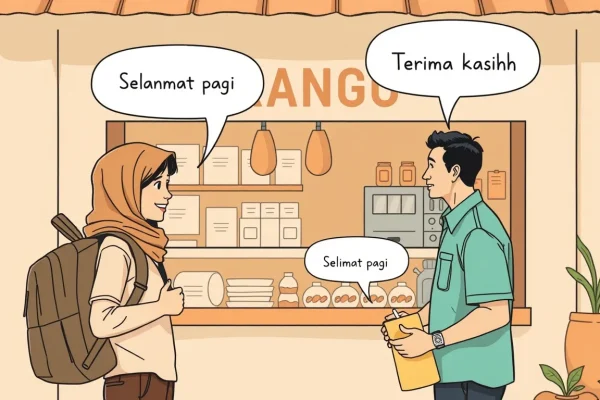
- Learn greetings and thanks first. Selamat pagi, terima kasih and permisi cover many small interactions. Say them clearly and do not worry about perfect pronunciation; the effort is usually appreciated.
- Use polite titles. Bapak (sir or father) and Ibu (madam or mother) are safe forms of address for many adults, especially strangers. Local terms such as Mas and Mbak in parts of Java are common, but they are more regional and informal; use them only if you hear them used around you.
- Keep requests short and literal. Translation apps can produce sentences that are too formal, too blunt or simply odd. A short Indonesian phrase, a point and a smile often works better than a long translated paragraph.
- Ask before switching to English. Bisa bicara bahasa Inggris? is a simple check. If the answer is no, continue in Indonesian or use a translation screen rather than repeating the same English sentence more loudly.
- Have addresses written in Indonesian. Jalan means street or road and is often abbreviated Jl. on signs and addresses. A driver or hotel clerk can read a written Indonesian address more reliably than an English place name pronounced from a guidebook.
- Do not treat regional languages as dialects of Indonesian. Javanese, Sundanese and Balinese are distinct languages with their own vocabularies and polite registers. A few Indonesian words are not a substitute. Use Indonesian as the neutral option unless you have learned otherwise.
What to confirm before you travel
Language ability is local and can change with staff, season and setting. Before you rely on English for something important, confirm it with the specific business or service. Ask your hotel whether airport transfers, tours and local guides can be conducted in English. For medical, legal or official matters, arrange a qualified interpreter or trusted local contact rather than assuming that tourist-level English will be enough.
If you are travelling beyond the main tourist areas, save an offline Indonesian dictionary or translation pack, write your destination and any allergy or dietary message in Indonesian, and keep a screenshot of your accommodation address. Test the translation app before departure, because offline packs and handwriting input can behave differently from online versions. For language learning, begin with listening and polite phrases rather than long sentences; locals will often help you finish.
This guide uses general official tourism and reference sources retrieved on November 6, 2026. It supports broad statements about the national language, English in major destinations and the names of regional languages. It does not assess individual businesses or guarantee English availability in any specific place. Local variation is the rule, not the exception.
A sensible next step
Before departure, save a short list of Indonesian phrases, ask your first accommodation which languages its staff use, and plan to use Indonesian as your default outside visitor-facing settings. For a concise official overview and common phrases, see the Indonesia Travel language page. If you plan to spend time in one region, add a local phrasebook or ask a guide about the local language. Indonesian will carry you through many situations, but it will not replace the regional languages that make the country multilingual.
FAQ
Do I need to speak Indonesian to visit Indonesia?
Not necessarily if you stay in main tourist areas, but a few phrases are useful and English is not universal. Outside visitor-heavy areas, Indonesian or a translation app is important for practical communication.
Is English widely spoken in Bali?
English is often understood in Bali’s main tourist areas, but it is not universal across the island. Indonesian and Balinese remain the local languages, and English may be limited in villages, local markets and non-tourist settings.
Is Bahasa Indonesia the same as Malay?
They are closely related; modern Indonesian was standardized from a Malay variety. Visitors should not assume they are identical in everyday or formal use.
Which regional language should I learn?
It depends on where you are going. Javanese and Sundanese are the most widely spoken regional languages, while Balinese is the local language in Bali. For most short visits, Indonesian is the more practical default.